19 Jun 2026
Referee Assignment Shifts Redefine Betting Dynamics in Card and Corner Markets Across Europe's Football Leagues

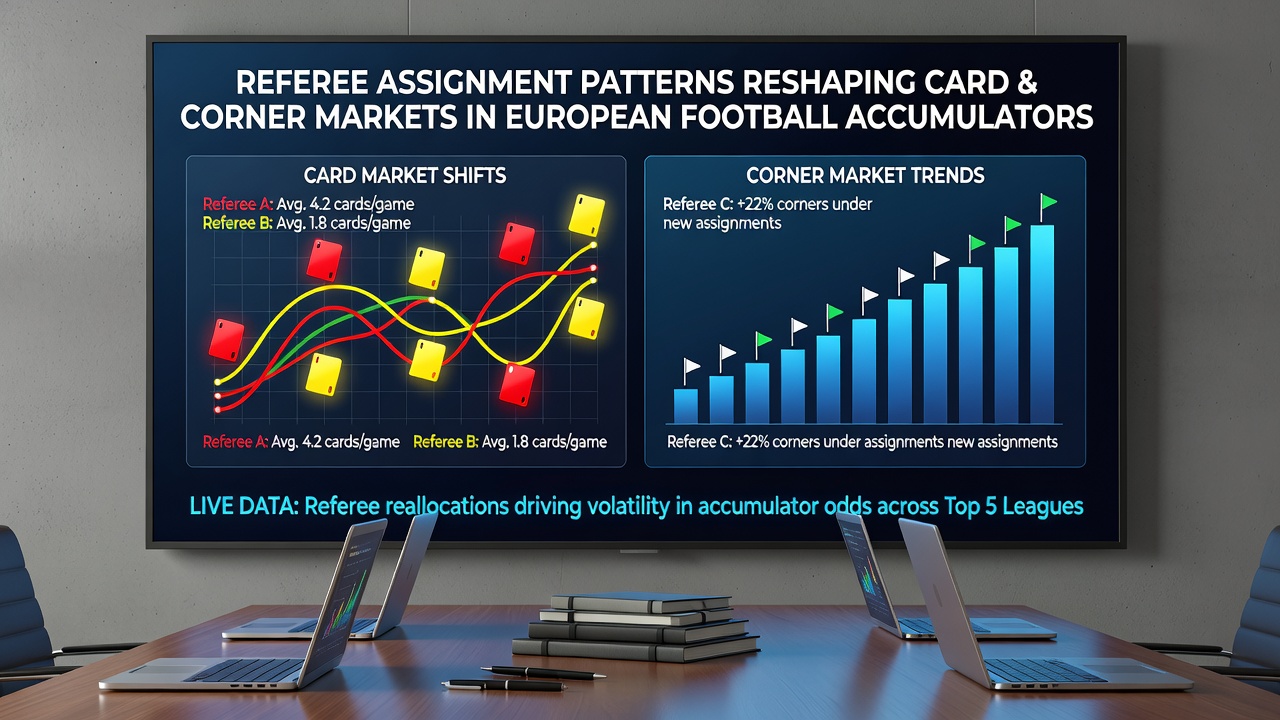
European football leagues have seen referee assignments follow clearer rotation patterns in recent seasons, and these schedules now feed directly into card and corner markets within accumulator bets. Data compiled by domestic federations shows that certain officials issue yellow cards at rates 18 percent above the league average while others maintain tighter thresholds that reduce overall bookings. Bettors tracking these assignments adjust their multi-leg selections accordingly, since a single referee change can alter expected card counts by two or more in a given fixture.
Rotation Schedules and Statistical Profiles
National associations publish referee appointments several days before matchdays, allowing detailed analysis of each official's historical output. In the Bundesliga, for example, referees average 4.8 yellow cards per game across a full campaign, yet individuals range from 3.2 to 6.7 depending on their assigned matches. Observers note that appointments to high-pressing teams correlate with elevated corner totals because those sides force more defensive clearances that produce set pieces. The same data reveals that referees who oversee matches involving teams ranked in the bottom third of the table record corner averages 1.4 higher than those handling top-six contests.
Similar patterns appear across Serie A and La Liga. Italian officials tend to award fewer cards early in campaigns and increase disciplinary interventions after the winter break, while Spanish referees maintain steadier rates year-round. Accumulator builders incorporate these seasonal shifts when selecting legs that include both card and corner propositions from multiple leagues on the same weekend.
Impact on Accumulator Construction
Multi-leg bets combining cards and corners require precise calibration because referee tendencies interact with team styles. A referee known for strict enforcement paired with two physical mid-table sides can push card overs well above standard lines. Conversely, appointments involving officials with lower card rates in matches between possession-dominant teams often suppress both bookings and corners. Research from the European Club Association indicates that 62 percent of matches featuring appointed referees with above-average card histories finish with at least five yellows when contested by sides averaging over 12 fouls per game.
June 2026 marks the start of pre-season referee training camps across major federations, where updated guidelines on VAR intervention thresholds receive emphasis. These sessions often produce measurable changes in card issuance during the opening weeks of the following campaign, prompting accumulator strategies to weight early fixtures differently until patterns stabilize.
League-Specific Variations
Premier League appointments demonstrate distinct clustering, with certain referees consistently assigned to London derbies or northern fixtures. Those officials show corner averages 0.9 higher in matches where both teams rank high in crosses per 90 minutes. In Ligue 1, referee rotation tends to pair stricter officials with clubs that commit higher foul rates away from home, creating pockets of value in card overs that repeat across multiple matchweeks.
Portuguese and Dutch leagues display narrower variances yet still reward attention to assignment lists. One study published by the University of Groningen tracked 420 Eredivisie matches and found that referee changes alone accounted for a 12 percent swing in expected corner totals when teams maintained consistent attacking profiles.
Data Integration in Modern Betting
Operators now supply referee-specific statistics within pre-match interfaces, allowing direct comparison against historical benchmarks. These figures include cards per foul, corners per shot, and average stoppage time, each broken down by competition. Accumulator platforms aggregate this information across five or six leagues, producing composite probabilities that reflect the specific officials appointed for that round. External analysis from sources such as UEFA technical reports and independent academic reviews supports these layered calculations.
Conclusion
Referee assignment patterns continue to supply measurable edges within card and corner segments of European accumulator markets. Federations release schedules that enable systematic review, while performance data from multiple competitions supplies the inputs needed for refined selections. As training protocols evolve ahead of June 2026, observers expect further refinement in how these patterns translate into betting lines across the continent's major leagues.